I want to leave the planet before I die, and the odds this site works out depend on seven kinds of things going right, from cheap launch to a seat for me. None of the seven is “we find a new world past Pluto”. So this post moves nothing. I am writing it because this site is also a place to keep up with what is being found in our own solar system, and this week something was.
What was found
On October 27th, 2026 the Rubin Observatory, a new survey telescope in Chile, announced its first candidate for a dwarf planet, an icy body with the provisional name 2026 ED138. Matthew Holman of the Center for Astrophysics found it on the evening of October 13th, 2026, running Rubin’s data from March 4th to July 11th, 2026 through a search program he wrote with a colleague, Kevin Napier. The Minor Planet Center, which keeps the register, published the orbit the same day.
It is now about 46 astronomical units from the Sun, where one unit is the distance from the Earth to the Sun. Pluto’s average distance is 40. From its brightness and distance, the team puts it between 600 and 1,500 kilometres across, and an icy body that large is expected to be round, which is the test a dwarf planet has to pass. Its orbit is tilted almost 25 degrees from the flat plane the planets move in. You can turn the orbit in three dimensions.
Once found, old pictures of it turned up. The team found 20 more Rubin observations back to March 4th, and, through the Asteroid Institute’s service for searching old sky images, pictures from the Dark Energy Camera going back to 2016, so more than ten years of its path are already known.
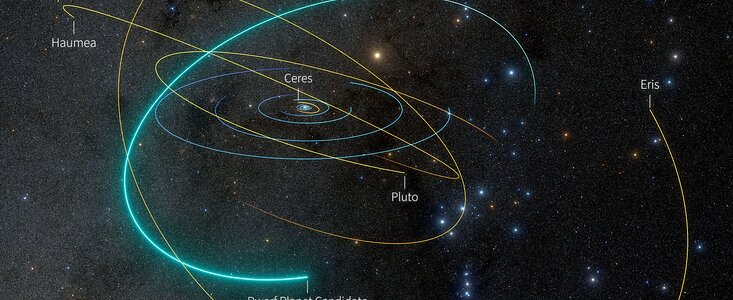
Why it is a candidate and not yet a dwarf planet
Brightness alone cannot fix a size, because a small bright body and a large dark one look the same from here. The release says plainly that observations in the infrared are needed to pin its size down and confirm what it is. If that confirms it, 2026 ED138 would join the five dwarf planets the International Astronomical Union recognises: Pluto, Ceres, Eris, Haumea and Makemake.
What it has to do with this site
The question the site asks is whether human industry reaches beyond Earth and Mars, and the outer solar system is the far end of that. But no step of the tree is about finding worlds, and this find changes no number. The nearest step is a hundred tonnes of material from an asteroid delivered to orbit in one year, and the honest link between that step and a world past Pluto is thin.
The nearer link is Rubin’s wider work. In April, before its main ten-year survey began, the observatory’s solar system team sent the Minor Planet Center more than 11,000 new asteroids from a month and a half of early data, among them about 380 icy bodies beyond Neptune. A telescope that maps the small bodies of the solar system at that pace makes the belt a known place rather than a guessed one, and knowing what is in the belt is a step toward using it. That is not a step on the tree. It is the map the steps will be walked on.
What to watch for
Two things. First, the infrared measurement of its size, which is what turns a candidate into a dwarf planet or not. Second, how many more of these the ten-year survey, which began in June 2026, turns up. When the size comes in, I will note it here. My odds will stay where they are. This post is the first of a new kind, a discovery, which says so up front.
Sources: The Rubin Observatory's announcement of October 27th, 2026 · The same announcement from the National Science Foundation · The Minor Planet Center's circular on 2026 ED138 · The orbit of 2026 ED138, which you can turn in three dimensions · The Rubin Observatory's release of April 2nd, 2026 on its first 11,000 asteroids · The orbit picture and its licence.
Follow the news: the feed · @SentHorizons on X · r/SentientHorizons on Reddit.