The European Space Agency announced on October 19th, 2026 that its Euclid space telescope has found its first previously unknown comet, now named C/2026 S1 (Euclid).
What was found
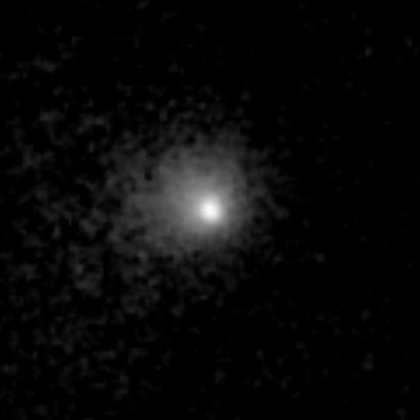
Euclid is a European space telescope built to map billions of distant galaxies, not to chase things in our own neighbourhood. Even so, in pictures it took between September 16th and 24th, 2026, software written by Mikko Pöntinen, a doctoral student at the University of Helsinki, flagged a streak smeared across several frames, which meant something was moving fast. He found it again in five sets of pictures, sixteen exposures in all, and a closer look showed a fuzzy cloud around it, the dust and gas a comet sheds. No catalogue of known comets or asteroids matched it.
He reported it to the Minor Planet Center, which keeps the official register of asteroids and comets, and telescopes on the ground followed it up. The Center confirmed it as a comet on October 8th, 2026 and gave it its official name, C/2026 S1 (Euclid). Euclid had photographed known comets before, but this is the first new one it has found.
Where it is going
When ESA announced it, the comet was about 1.3 billion kilometres from Earth, somewhere between the distances of Jupiter and Saturn from the Sun. It does not travel in the flat plane the planets move in: its orbit is tilted 85 degrees, so from the Sun it sits almost straight up, arching over the solar system.
It will come closest to the Sun around September 13th, 2027, when it will still be about 8.7 times as far from the Sun as the Earth is, just inside Saturn’s orbit. On the orbit worked out so far, one trip around the Sun takes something like 150,000 years. ESA says only that it takes thousands of years and that the figure will be refined as more observations come in, so treat the exact number as a first guess.
Why it was hard to find
Euclid deliberately looks away from the band of sky along the planets’ plane, where most asteroids and comets are, because their dust adds glare to its deep pictures. It also usually looks at each patch of sky only once, so it cannot go back to check a moving thing. This comet was caught because its steep orbit carried it through the patch Euclid happened to be photographing over those days, which ESA’s release calls “a happy coincidence”.
A rehearsal for Comet Interceptor
ESA’s Comet Interceptor mission will wait in space for a fresh comet to visit, and finding candidates early, while they are still far from the Sun, is what makes that possible. This comet is not a suitable target, but ESA calls the process of finding it and raising the alert a real test case for how the two mission teams will work together.
What to watch for
Astronomers will refine the orbit as they follow the comet toward its closest pass in 2027. The other thing to watch is whether Euclid’s software, built to clean moving things out of its galaxy pictures, turns up more comets.
Sources: ESA's announcement of October 19th, 2026 · The Minor Planet Center's circular on C/2026 S1 (Euclid), issued October 8th, 2026 · The Minor Planet Center's current orbit for C/2026 S1 (Euclid) · The picture and its licence.
Follow the news: the feed · @SentHorizons on X · r/SentientHorizons on Reddit.